 Add to Chrome
 Add to Firefox
 Add to Edge
Abnormal behavior recognition
Papers and Code
A Real-Time Privacy-Preserving Behavior Recognition System via Edge-Cloud Collaboration
Jan 30, 2026
As intelligent sensing expands into high-privacy environments such as restrooms and changing rooms, the field faces a critical privacy-security paradox. Traditional RGB surveillance raises significant concerns regarding visual recording and storage, while existing privacy-preserving methods-ranging from physical desensitization to traditional cryptographic or obfuscation techniques-often compromise semantic understanding capabilities or fail to guarantee mathematical irreversibility against reconstruction attacks. To address these challenges, this study presents a novel privacy-preserving perception technology based on the AI Flow theoretical framework and an edge-cloud collaborative architecture. The proposed methodology integrates source desensitization with irreversible feature mapping. Leveraging Information Bottleneck theory, the edge device performs millisecond-level processing to transform raw imagery into abstract feature vectors via non-linear mapping and stochastic noise injection. This process constructs a unidirectional information flow that strips identity-sensitive attributes, rendering the reconstruction of original images impossible. Subsequently, the cloud platform utilizes multimodal family models to perform joint inference solely on these abstract vectors to detect abnormal behaviors. This approach fundamentally severs the path to privacy leakage at the architectural level, achieving a breakthrough from video surveillance to de-identified behavior perception and offering a robust solution for risk management in high-sensitivity public spaces.

Improving Pattern Recognition of Scheduling Anomalies through Structure-Aware and Semantically-Enhanced Graphs
Dec 21, 2025This paper proposes a structure-aware driven scheduling graph modeling method to improve the accuracy and representation capability of anomaly identification in scheduling behaviors of complex systems. The method first designs a structure-guided scheduling graph construction mechanism that integrates task execution stages, resource node states, and scheduling path information to build dynamically evolving scheduling behavior graphs, enhancing the model's ability to capture global scheduling relationships. On this basis, a multi-scale graph semantic aggregation module is introduced to achieve semantic consistency modeling of scheduling features through local adjacency semantic integration and global topology alignment, thereby strengthening the model's capability to capture abnormal features in complex scenarios such as multi-task concurrency, resource competition, and stage transitions. Experiments are conducted on a real scheduling dataset with multiple scheduling disturbance paths set to simulate different types of anomalies, including structural shifts, resource changes, and task delays. The proposed model demonstrates significant performance advantages across multiple metrics, showing a sensitive response to structural disturbances and semantic shifts. Further visualization analysis reveals that, under the combined effect of structure guidance and semantic aggregation, the scheduling behavior graph exhibits stronger anomaly separability and pattern representation, validating the effectiveness and adaptability of the method in scheduling anomaly detection tasks.
AnomalyLMM: Bridging Generative Knowledge and Discriminative Retrieval for Text-Based Person Anomaly Search
Sep 04, 2025With growing public safety demands, text-based person anomaly search has emerged as a critical task, aiming to retrieve individuals with abnormal behaviors via natural language descriptions. Unlike conventional person search, this task presents two unique challenges: (1) fine-grained cross-modal alignment between textual anomalies and visual behaviors, and (2) anomaly recognition under sparse real-world samples. While Large Multi-modal Models (LMMs) excel in multi-modal understanding, their potential for fine-grained anomaly retrieval remains underexplored, hindered by: (1) a domain gap between generative knowledge and discriminative retrieval, and (2) the absence of efficient adaptation strategies for deployment. In this work, we propose AnomalyLMM, the first framework that harnesses LMMs for text-based person anomaly search. Our key contributions are: (1) A novel coarse-to-fine pipeline integrating LMMs to bridge generative world knowledge with retrieval-centric anomaly detection; (2) A training-free adaptation cookbook featuring masked cross-modal prompting, behavioral saliency prediction, and knowledge-aware re-ranking, enabling zero-shot focus on subtle anomaly cues. As the first study to explore LMMs for this task, we conduct a rigorous evaluation on the PAB dataset, the only publicly available benchmark for text-based person anomaly search, with its curated real-world anomalies covering diverse scenarios (e.g., falling, collision, and being hit). Experiments show the effectiveness of the proposed method, surpassing the competitive baseline by +0.96% Recall@1 accuracy. Notably, our method reveals interpretable alignment between textual anomalies and visual behaviors, validated via qualitative analysis. Our code and models will be released for future research.
YOLOv8-Based Deep Learning Model for Automated Poultry Disease Detection and Health Monitoring paper
Aug 06, 2025In the poultry industry, detecting chicken illnesses is essential to avoid financial losses. Conventional techniques depend on manual observation, which is laborious and prone to mistakes. Using YOLO v8 a deep learning model for real-time object recognition. This study suggests an AI based approach, by developing a system that analyzes high resolution chicken photos, YOLO v8 detects signs of illness, such as abnormalities in behavior and appearance. A sizable, annotated dataset has been used to train the algorithm, which provides accurate real-time identification of infected chicken and prompt warnings to farm operators for prompt action. By facilitating early infection identification, eliminating the need for human inspection, and enhancing biosecurity in large-scale farms, this AI technology improves chicken health management. The real-time features of YOLO v8 provide a scalable and effective method for improving farm management techniques.
Deep Learning For Time Series Analysis With Application On Human Motion
Feb 26, 2025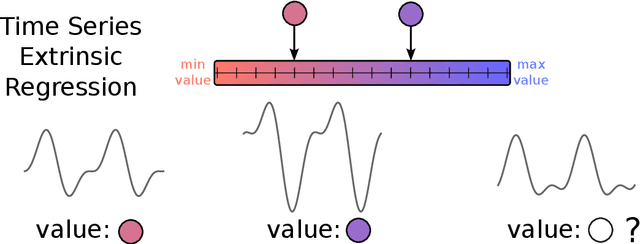
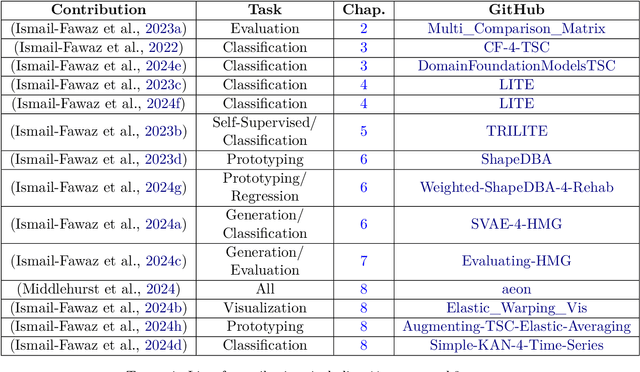
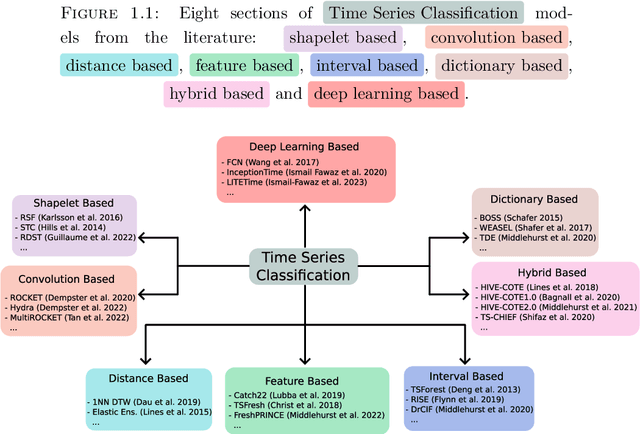
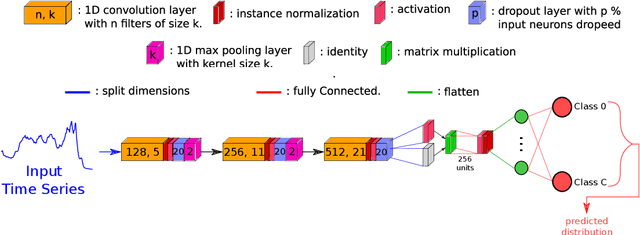
Time series data, defined by equally spaced points over time, is essential in fields like medicine, telecommunications, and energy. Analyzing it involves tasks such as classification, clustering, prototyping, and regression. Classification identifies normal vs. abnormal movements in skeleton-based motion sequences, clustering detects stock market behavior patterns, prototyping expands physical therapy datasets, and regression predicts patient recovery. Deep learning has recently gained traction in time series analysis due to its success in other domains. This thesis leverages deep learning to enhance classification with feature engineering, introduce foundation models, and develop a compact yet state-of-the-art architecture. We also address limited labeled data with self-supervised learning. Our contributions apply to real-world tasks, including human motion analysis for action recognition and rehabilitation. We introduce a generative model for human motion data, valuable for cinematic production and gaming. For prototyping, we propose a shape-based synthetic sample generation method to support regression models when data is scarce. Lastly, we critically evaluate discriminative and generative models, identifying limitations in current methodologies and advocating for a robust, standardized evaluation framework. Our experiments on public datasets provide novel insights and methodologies, advancing time series analysis with practical applications.
Efficient Vision Language Model Fine-tuning for Text-based Person Anomaly Search
Feb 05, 2025
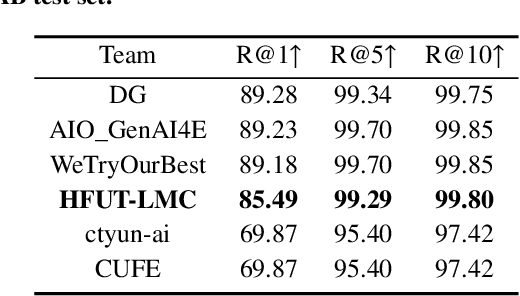

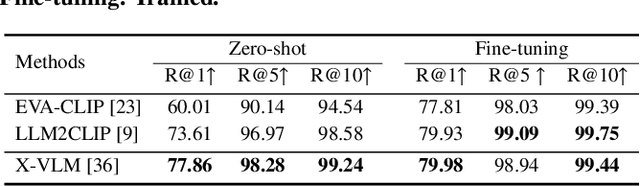
This paper presents the HFUT-LMC team's solution to the WWW 2025 challenge on Text-based Person Anomaly Search (TPAS). The primary objective of this challenge is to accurately identify pedestrians exhibiting either normal or abnormal behavior within a large library of pedestrian images. Unlike traditional video analysis tasks, TPAS significantly emphasizes understanding and interpreting the subtle relationships between text descriptions and visual data. The complexity of this task lies in the model's need to not only match individuals to text descriptions in massive image datasets but also accurately differentiate between search results when faced with similar descriptions. To overcome these challenges, we introduce the Similarity Coverage Analysis (SCA) strategy to address the recognition difficulty caused by similar text descriptions. This strategy effectively enhances the model's capacity to manage subtle differences, thus improving both the accuracy and reliability of the search. Our proposed solution demonstrated excellent performance in this challenge.
2D bidirectional gated recurrent unit convolutional Neural networks for end-to-end violence detection In videos
Sep 11, 2024Abnormal behavior detection, action recognition, fight and violence detection in videos is an area that has attracted a lot of interest in recent years. In this work, we propose an architecture that combines a Bidirectional Gated Recurrent Unit (BiGRU) and a 2D Convolutional Neural Network (CNN) to detect violence in video sequences. A CNN is used to extract spatial characteristics from each frame, while the BiGRU extracts temporal and local motion characteristics using CNN extracted features from multiple frames. The proposed end-to-end deep learning network is tested in three public datasets with varying scene complexities. The proposed network achieves accuracies up to 98%. The obtained results are promising and show the performance of the proposed end-to-end approach.
* 8 pages, 6 figures, 2020 International Conference on Image Analysis and Recognition (ICIAR)
A Critical Analysis on Machine Learning Techniques for Video-based Human Activity Recognition of Surveillance Systems: A Review
Sep 01, 2024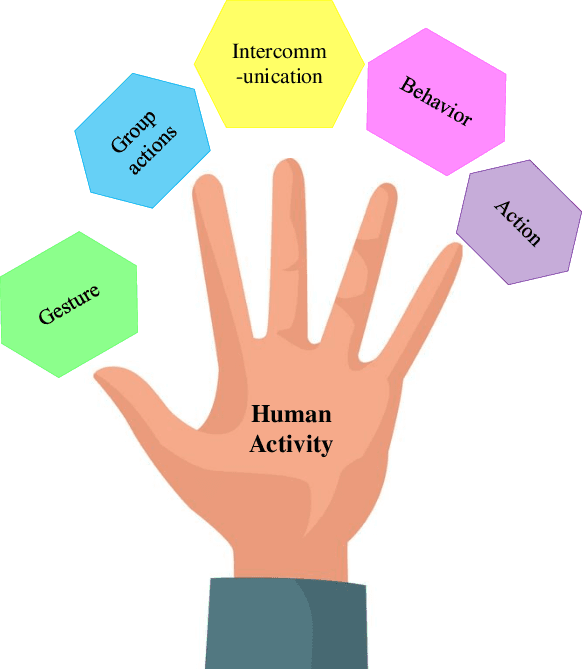

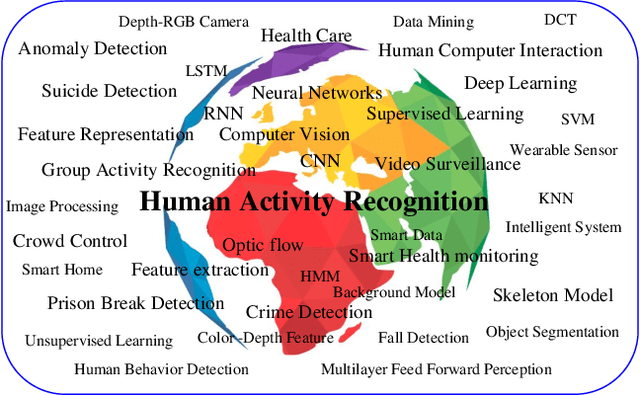
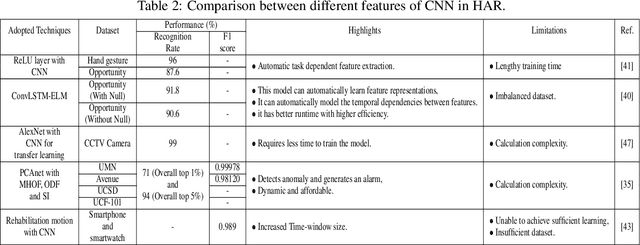
Upsurging abnormal activities in crowded locations such as airports, train stations, bus stops, shopping malls, etc., urges the necessity for an intelligent surveillance system. An intelligent surveillance system can differentiate between normal and suspicious activities from real-time video analysis that will enable to take appropriate measures regarding the level of an anomaly instantaneously and efficiently. Video-based human activity recognition has intrigued many researchers with its pressing issues and a variety of applications ranging from simple hand gesture recognition to crucial behavior recognition in a surveillance system. This paper provides a critical survey of video-based Human Activity Recognition (HAR) techniques beginning with an examination of basic approaches for detecting and recognizing suspicious behavior followed by a critical analysis of machine learning and deep learning techniques such as Convolutional Neural Network (CNN), Recurrent Neural Network (RNN), Hidden Markov Model (HMM), K-means Clustering etc. A detailed investigation and comparison are done on these learning techniques on the basis of feature extraction techniques, parameter initialization, and optimization algorithms, accuracy, etc. The purpose of this review is to prioritize positive schemes and to assist researchers with emerging advancements in this field's future endeavors. This paper also pragmatically discusses existing challenges in the field of HAR and examines the prospects in the field.
SMART: Scene-motion-aware human action recognition framework for mental disorder group
Jun 07, 2024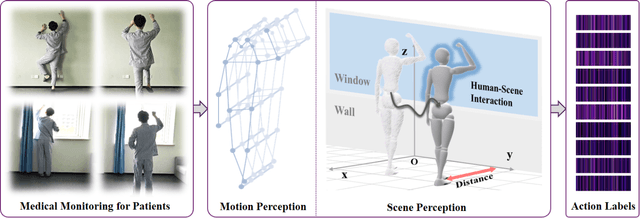

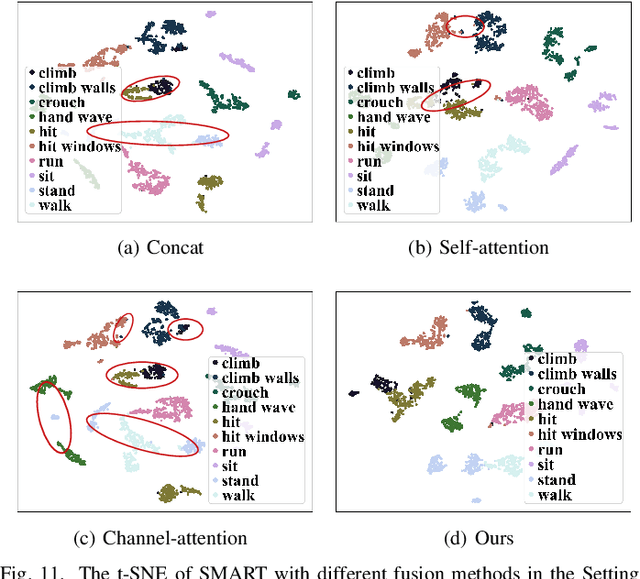
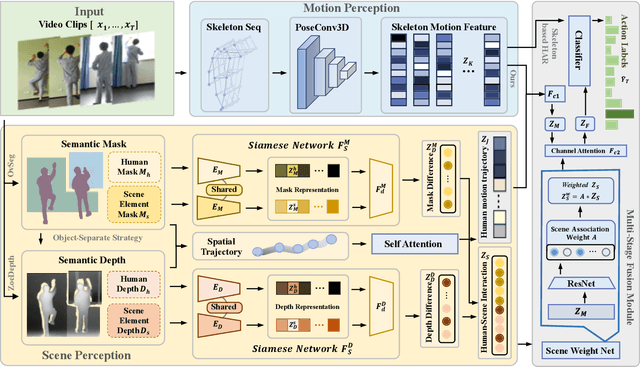
Patients with mental disorders often exhibit risky abnormal actions, such as climbing walls or hitting windows, necessitating intelligent video behavior monitoring for smart healthcare with the rising Internet of Things (IoT) technology. However, the development of vision-based Human Action Recognition (HAR) for these actions is hindered by the lack of specialized algorithms and datasets. In this paper, we innovatively propose to build a vision-based HAR dataset including abnormal actions often occurring in the mental disorder group and then introduce a novel Scene-Motion-aware Action Recognition Technology framework, named SMART, consisting of two technical modules. First, we propose a scene perception module to extract human motion trajectory and human-scene interaction features, which introduces additional scene information for a supplementary semantic representation of the above actions. Second, the multi-stage fusion module fuses the skeleton motion, motion trajectory, and human-scene interaction features, enhancing the semantic association between the skeleton motion and the above supplementary representation, thus generating a comprehensive representation with both human motion and scene information. The effectiveness of our proposed method has been validated on our self-collected HAR dataset (MentalHAD), achieving 94.9% and 93.1% accuracy in un-seen subjects and scenes and outperforming state-of-the-art approaches by 6.5% and 13.2%, respectively. The demonstrated subject- and scene- generalizability makes it possible for SMART's migration to practical deployment in smart healthcare systems for mental disorder patients in medical settings. The code and dataset will be released publicly for further research: https://github.com/Inowlzy/SMART.git.
Uncovering the Unseen: Discover Hidden Intentions by Micro-Behavior Graph Reasoning
Aug 29, 2023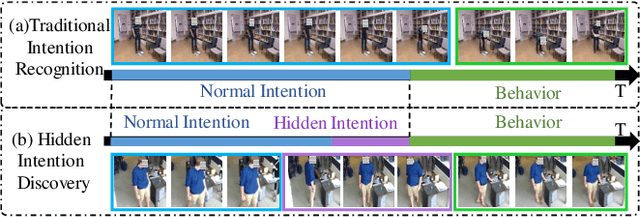
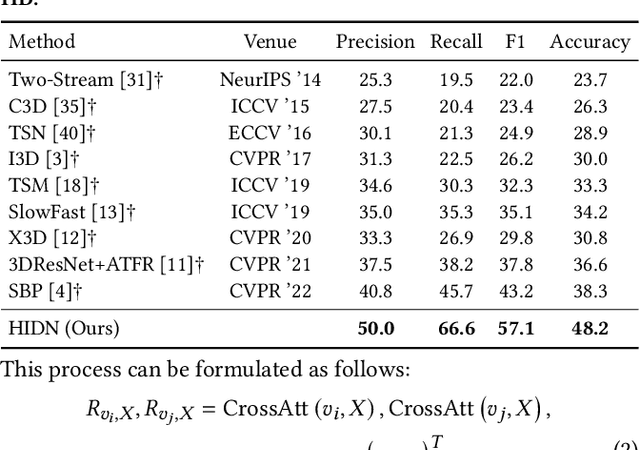
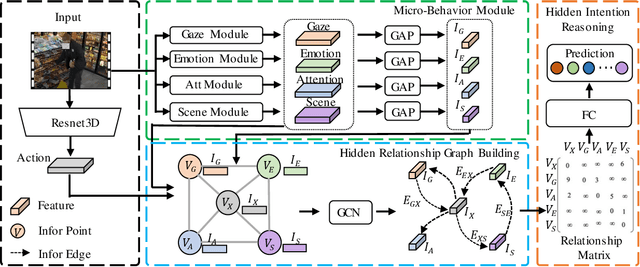
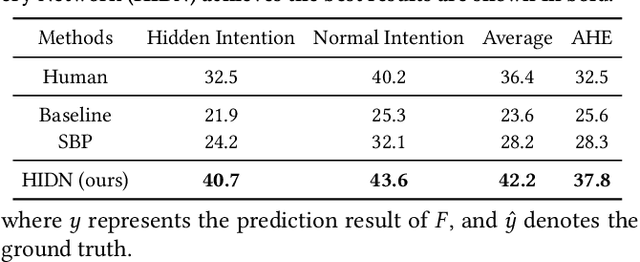
This paper introduces a new and challenging Hidden Intention Discovery (HID) task. Unlike existing intention recognition tasks, which are based on obvious visual representations to identify common intentions for normal behavior, HID focuses on discovering hidden intentions when humans try to hide their intentions for abnormal behavior. HID presents a unique challenge in that hidden intentions lack the obvious visual representations to distinguish them from normal intentions. Fortunately, from a sociological and psychological perspective, we find that the difference between hidden and normal intentions can be reasoned from multiple micro-behaviors, such as gaze, attention, and facial expressions. Therefore, we first discover the relationship between micro-behavior and hidden intentions and use graph structure to reason about hidden intentions. To facilitate research in the field of HID, we also constructed a seminal dataset containing a hidden intention annotation of a typical theft scenario for HID. Extensive experiments show that the proposed network improves performance on the HID task by 9.9\% over the state-of-the-art method SBP.